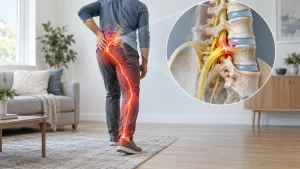

Back pain that travels into the hip or down the leg can slowly begin to affect everything from sleep to concentration. At first, it may feel like something that will pass. Then it lingers. Sitting becomes uncomfortable. You start adjusting how you move without realizing it.
For many people, this is when they begin looking into herniated disc pain management. Not because they want something aggressive, but because they want clarity. The reassuring truth is that herniated disc pain can often be managed without surgery. Seeking guidance does not mean committing to injections or an operation. It means understanding what is happening and building a plan around it.
Care should focus on minimally invasive, non-surgical solutions whenever possible. The goal is to reduce inflammation, restore movement, and help patients return to daily life with less disruption.
When Herniated Disc Symptoms Suggest It Is Time for Structured Care
It is reasonable to begin conservatively. Rest, posture adjustments, and anti-inflammatory medication are often helpful in the early phase. Many mild disc injuries improve within several weeks.
However, when disc material irritates a nearby nerve root, symptoms rarely stay confined to the lower back. Pain may travel down the leg, sometimes accompanied by tingling, numbness, or weakness. A useful analogy is this: a nerve behaves like a live wire. When it is irritated, symptoms can travel far from the source.
When several weeks pass without steady improvement, or when sleep, work, and daily movement are clearly affected, structured evaluation becomes appropriate. At that stage, herniated disc pain management can provide targeted treatment designed to calm inflammation before the condition becomes chronic.
Understanding the Typical Recovery Timeline for Herniated Disc Procedures
Patients often want clarity about how long recovery may take. In general, the typical duration of herniated disc pain varies based on nerve irritation severity and individual healing factors.
In the first one to two weeks, inflammation is usually the primary source of discomfort. The irritated nerve becomes sensitive, and movements may feel sharper than expected. Balanced activity during this phase is important. Excessive rest can lead to stiffness, while too much strain may prolong irritation.
Between weeks3 and 6, gradual improvement is common. Pain may not disappear entirely, but it typically becomes more manageable. If symptoms extend beyond six to eight weeks without meaningful progress, further evaluation is recommended.
Several factors influence recovery, including posture, occupational demands, prior disc flare-ups, and muscle guarding. In these situations, structured herniated disc pain management may reduce inflammation and help restore mobility while the disc continues to stabilize.
The Most Effective Non-Surgical Treatments for a Herniated Disc
Treatment for a herniated disc usually progresses in stages rather than jumping directly to invasive procedures. Patients frequently want to understand what conservative care truly involves.
Physical therapy is often the starting point. Strengthening the muscles that stabilize the spine reduces mechanical stress on the injured disc. Even subtle improvements in posture and body mechanics can make a meaningful difference over time.
Short-term medication may be used to reduce inflammation and calm nerve irritation. The purpose is to create a window that allows rehabilitation to progress, not to rely on medication indefinitely.
It is important to understand that the most effective non-surgical treatments for a herniated disc typically involve a stepwise, individualized approach. Care can be compared to a toolbox. Most individuals do not need the most aggressive tool first. Escalation occurs only when it meaningfully improves comfort and function.
At Augusta Pain Center, treatment plans are tailored to each patient. Evaluation includes detailed discussion, focused examination, and imaging review when appropriate.
The Effectiveness of Epidural Steroid Injections for Herniated Disc Pain
For some patients, inflammation around the nerve root remains significant despite conservative measures. In these cases, targeted injections may be considered.
Epidural steroid injections deliver anti-inflammatory medication directly to the irritated area. The procedure is performed in an outpatient setting using imaging guidance for precision. Relief may begin within days or build gradually over one to two weeks.
In the appropriate clinical setting, epidural steroid injections can be effective for herniated disc pain when nerve inflammation is the primary driver of symptoms. By calming inflammation, injections allow more comfortable movement and better participation in rehabilitation.
Within a broader herniated disc pain management strategy, injections serve as one component of a comprehensive plan rather than a standalone solution.
Signs That Point Toward Herniated Disc Surgery
Concerns about surgery are common when imaging confirms a herniated disc. However, surgery is rarely the first recommendation.
Progressive muscle weakness, significant neurological deficits, bowel or bladder changes, or severe persistent pain that does not respond to structured conservative care may warrant surgical consultation. These are specific clinical indicators rather than routine findings.
It is important to remember that surgery for a herniated disc is typically necessary only when specific neurological or functional criteria are met. Before that point, pain management plays a central role in confirming the diagnosis and exploring non-surgical options.
If surgical referral becomes appropriate, it is made thoughtfully and without unnecessary delay.
Understanding Your First Pain Management Appointment
Choosing to schedule an evaluation is not a commitment to a procedure. It is a step toward clarity.
At Augusta Pain Center, the visit begins with listening. You will discuss how the pain started, how it has changed, and how it affects daily life. Functional limitations are considered alongside imaging findings. If prior imaging is available, it is reviewed carefully. If not, guidance is provided about whether imaging is needed.
You will leave with a personalized plan and a clear understanding of how progress will be measured. With a thoughtful approach to herniated disc pain management, many patients regain stability, mobility, and confidence without ever needing surgery.