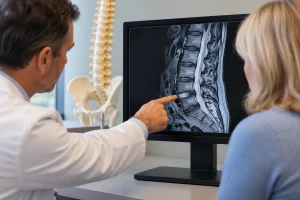

If your back pain starts inside your vertebrae, the Intracept procedure can be well worth it. When the vertebrae are the source, the relief tends to stick, and many people in long-term studies still feel the difference five years on. It’s a same-day procedure, and most people are back to light routines within a few days.
If you’ve lived with back pain for a long time, a new procedure can be both appealing and a little daunting, so it’s fair to want the details first. Is it surgery? How long will you be out of action, and what are the risks? How is it different from the radiofrequency ablation your doctor may have already mentioned? Knowing what to expect makes it a lot easier to decide whether Intracept fits your situation.
What Is the Intracept Procedure for Back Pain?
The Intracept procedure for back pain is a treatment called basivertebral nerve ablation, or BVNA. Intracept is the brand name of the system used to perform it, and it’s the name most patients know it by. The procedure targets the basivertebral nerve, a small nerve that runs inside each vertebra of the lower spine. When the thin plates at the top and bottom of a vertebra (called endplates) wear down or become damaged, that nerve starts reporting the damage as pain, a pattern known as vertebrogenic back pain.
The basivertebral nerve works like a cable carrying pain signals out of the vertebra. The Intracept procedure uses controlled heat, delhttp://blog/vertebrogenic-back-pain-may-already-be-showing-up-on-your-mri/ivered through a thin probe, to switch off that one cable, so the signal stops while the vertebra itself stays in place.
Who Basivertebral Nerve Ablation Works Best For
Basivertebral nerve ablation is designed for adults whose low back pain has lasted at least 6 months, hasn’t eased with conservative care, and lines up with specific MRI findings at the vertebrae called Modic changes.
If your pain mostly travels down your leg, BVNA probably isn’t the right fit. Leg pain like that usually comes from an irritated nerve root in the lower spine, the cause behind most sciatica and lumbar radiculopathy, and it tends to respond better to treatment aimed at that nerve, such as an epidural steroid injection. BVNA may also be ruled out if you’re pregnant, have an active infection, or have a pacemaker or another implanted electronic device.
What to Expect on the Day of Your Intracept Procedure
Intracept is one of several lower back procedures we perform on an outpatient basis at our on-site surgery center in Augusta, GA. It usually takes 60 to 90 minutes, and you’ll receive anesthesia, so plan for someone to drive you home.
Using live X-ray imaging as a guide, Dr. Epter, an interventional pain specialist, makes one small opening in your lower back and passes a thin probe into the affected vertebra. Once the probe reaches the basivertebral nerve, radiofrequency energy switches off that cable, and the nerve stops sending pain signals.
Is the Intracept Procedure Considered Back Surgery?
Intracept takes place in a surgical setting, but it isn’t back surgery in the way most people picture it. Traditional spine surgery, such as a fusion or a discectomy, removes or rebuilds part of the spine, sometimes leaves screws or rods behind, and often means a hospital stay followed by months of recovery.
Intracept works through one small opening that usually needs only a few stitches. Nothing is removed, rebuilt, or implanted, and the structure of your spine stays exactly as it was, which is what makes it a minimally invasive alternative to surgery.
What Is the Intracept Procedure Recovery Time?
The Intracept procedure recovery time is 1 to 2 weeks for most people, and many are back to light routines and desk work within 2 or 3 days. For the first couple of weeks, the limits are simple: skip heavy lifting and strenuous activity, hold off on driving for the first few days, and keep walking, which helps.
Pain relief often follows within about 3 weeks, though some people notice it sooner. In a randomized trial published in Regional Anesthesia & Pain Medicine, 73% of patients who had the procedure reported a meaningful drop in pain by the three-month mark, compared with 33% of those who stayed on standard care. Pairing recovery with physical and aquatic therapy helps rebuild the strength and confidence that months of pain may have chipped away.
What Are the Side Effects of the Intracept Procedure?
Intracept procedure side effects are usually mild, and most fade within a few days. Here’s what people tend to notice, and what’s less likely:
- Common: soreness, minor swelling, or bruising where the probe went in, usually managed with over-the-counter pain relievers.
- Less common: a temporary increase in back pain, infection, bleeding, or nerve irritation.
Serious Intracept procedure side effects are uncommon, and your health history is reviewed at your consultation to make sure the procedure is a safe choice.
How Intracept Differs From Radiofrequency Ablation
Both procedures use radiofrequency energy to quiet a nerve, so they’re easy to mix up. The difference is which nerve, and why. Comparing the Intracept procedure vs. radiofrequency ablation comes down to where your pain begins: inside the vertebra itself, or in the small facet joints that connect one vertebra to the next. Facet radiofrequency ablation is a long-standing form of ablation for low back pain that comes from those joints.
Intracept Procedure vs. Radiofrequency Ablation at a Glance
The Intracept procedure (BVNA) treats the basivertebral nerve inside the vertebra. It’s used when damaged endplates are the source of pain, which shows up as Modic changes on an MRI. Relief has been tracked for up to 5 years in studies, and the procedure is typically done once per treated level.
Facet radiofrequency ablation treats the medial branch nerves that serve the facet joints. It’s used when arthritic or irritated facet joints are the source of pain, which is confirmed by relief after diagnostic nerve blocks. Relief usually lasts several months to a year or longer, and the procedure can be repeated as the nerves regrow.
Each one treats a different source of pain, so the better fit for you depends on where yours is coming from, and that’s something we work out together during your evaluation.
How Long Does Relief Last After the Intracept Procedure for Back Pain?
Relief can last for years, which sets Intracept apart from treatments that wear off and need repeating. 5-year follow-up data from 3 studies, published in Brain and Spine in 2025, tracked 320 patients who had the procedure. Of those who completed the five-year visit, 83% still reported a meaningful drop in pain, 69% had returned to their previous activity level, and 32% said they were pain-free. Results vary from person to person, so be sure to speak with your pain management specialist.
Getting the Intracept Procedure at Augusta Pain Center
Whether Intracept is worth it for you comes down to one question: is your pain really coming from the vertebrae? When the answer is yes, the evidence is strong. When it’s no, a different treatment will serve you better.
Dr. Richard Epter founded Augusta Pain Center in 2001 and performs the Intracept procedure himself. He holds 5 pain board certifications and a board certification in anesthesiology, and he helps train pain management fellows as a Clinical Assistant Professor at the Medical College of Georgia.
Patients across Augusta, GA and the Central Savannah River Area come to us for clear answers before they decide on treatment. A consultation doesn’t commit you to a procedure. It tells you where your pain is coming from and which treatment fits it. Request an appointment to find out whether the Intracept procedure for back pain is the right next step for you.