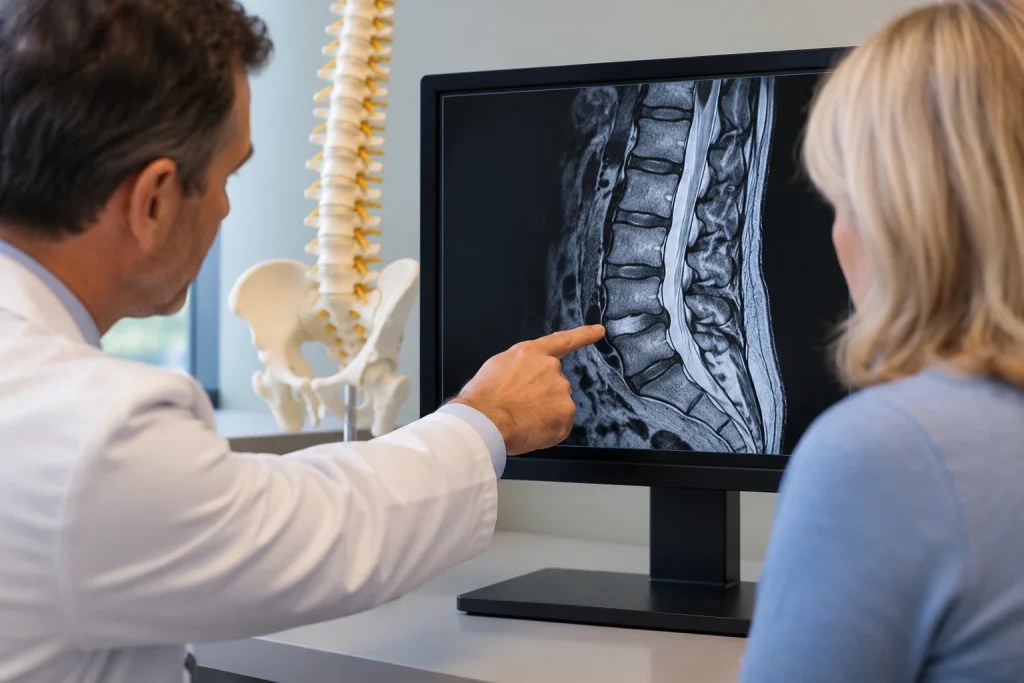
If deep pain in the center of your lower back has lasted for months, and every explanation so far has come down to “wear and tear,” the cause may already be in your MRI report. Vertebrogenic low back pain starts in the vertebrae themselves, at the endplates where bone meets disc, rather than in the discs or joints. It often appears on imaging as Modic changes, a finding many patients never hear explained. When your imaging and symptoms line up, Augusta Pain Center offers a treatment built for it.
What Is Vertebrogenic Low Back Pain?
Vertebrogenic low back pain comes from the vertebral endplates, the thin layers of bone and cartilage at the top and bottom of each vertebra where it meets a disc. Your endplates absorb pressure every time you sit, stand, or bend, and over the years they can develop small areas of damage and inflammation.
A nerve inside each vertebra, called the basivertebral nerve, picks up signals from those damaged endplates and passes them along as pain. Treatment aimed at the disc or the facet joints won’t reach a signal traveling through that nerve, which may explain why care that made sense on paper never quite worked.
Vertebrogenic Pain Symptoms and What Makes Them Worse
Where Vertebrogenic Pain Is Felt
Vertebrogenic pain usually sits deep in the middle of the lower back, along the spine rather than off to one side. Patients often describe an ache coming from inside the spine rather than the muscles, and it tends to stay in the back. When pain shoots through the buttock and down the leg, an irritated nerve root is the more likely explanation.
What Triggers a Vertebrogenic Pain Flare
Sitting for long stretches is one of the most common triggers. Bending forward, lifting, and long days on your feet can all make it worse. Lying down may take the edge off, but the ache often returns once you’re back at a desk or behind the wheel. Most patients researching vertebrogenic pain have lived with this pattern for 6 months or more.
What Are Modic Changes on an MRI?
Modic changes are signs of damage and inflammation in the vertebral endplates and the bone just beneath them, visible on an MRI. They are one of the clearest imaging clues that vertebrogenic pain may be behind chronic lower back pain.
Radiologists generally describe two main types:
Type 1 Modic changes reflect active inflammation and swelling in the bone.
Type 2 Modic changes reflect longer-standing changes, where some of the bone marrow has been replaced by fat.
Both types can be associated with vertebrogenic pain, yet these findings often appear in a report without anyone explaining what they mean.
Does your MRI mention Modic or endplate changes? Request an appointment and bring the report so our team can review it with you.
Vertebrogenic Pain vs. Disc Pain vs. Facet Joint Pain
The endplates sit directly against the discs, so problems in both areas often show up on the same MRI and get grouped under one label, degenerative disc disease. If the endplates were driving the pain all along, treatment aimed at the disc brings partial relief at best.
Each common source of chronic lower back pain leaves a different clue.
If the pain stays deep in the center of your back and flares when you sit, bend forward, or lift, vertebrogenic pain is a strong possibility. Matching Modic changes on an MRI confirm it.
If the pain travels into your buttock or leg, or spikes when you cough or sneeze, a disc is more likely involved.
If the pain sits off to one side and gets worse when you lean back, twist, or stand for long periods, the facet joints may be the source. A diagnostic nerve block usually confirms it.
How a Pain Specialist Diagnoses Vertebrogenic Pain
Diagnosing vertebrogenic pain means matching three pieces of information: your pain pattern, a hands-on exam, and your MRI. A pain specialist asks where the pain sits and what sets it off, rules out other sources such as the facet joints or a compressed nerve root, then reviews your imaging for Modic changes at the levels that match your symptoms.
The imaging and the symptoms need to agree, and imaging from the past year or so may be enough to get started.
Modic Changes Treatment With the Intracept Procedure
When vertebrogenic pain is confirmed and months of conservative care haven’t brought lasting relief, basivertebral nerve ablation treats the source directly. Dr. Richard Epter performs the Intracept procedure in Augusta, GA at our on-site surgery center, treating the nerve itself rather than managing the pain around it.
The outpatient procedure is done through small openings in the skin. Using imaging guidance, the physician reaches the basivertebral nerve inside the affected vertebra and applies targeted radiofrequency energy so the nerve stops sending pain signals.
Basivertebral nerve ablation is typically a good fit for patients who:
- Have had chronic low back pain for at least six months
- Have tried at least six months of conservative care, such as physical therapy or medication, without lasting relief
- Have MRI findings showing Type 1 or Type 2 Modic changes at the levels that match their pain
- Feel their pain mostly in the back rather than down the leg
Patients whose main problem is leg pain, or whose imaging points to a different source, are usually better served by other options. Physical and aquatic therapy and medical management also help rebuild strength and keep progress steady after the procedure.
Finding the Cause of Your Chronic Lower Back Pain at Augusta Pain Center
“Wear and tear” describes your age, not the cause of your pain. If vertebrogenic low back pain is what you’ve been living with, the answer may be on an MRI you already have. Dr. Epter and our pain management team help patients across the CSRA connect their imaging to their pain and match a confirmed source to a treatment designed for it.
An evaluation is about getting answers, not committing to a procedure. Request an appointment online or call (706) 738-7246 to find out whether the Intracept procedure is right for you.