
If you’ve spent months, maybe years, chasing relief for low back, hip, or buttock pain, you already know the drill: physical therapy that plateaued, injections that wore off, treatment aimed at your spine that never touched what you actually felt.
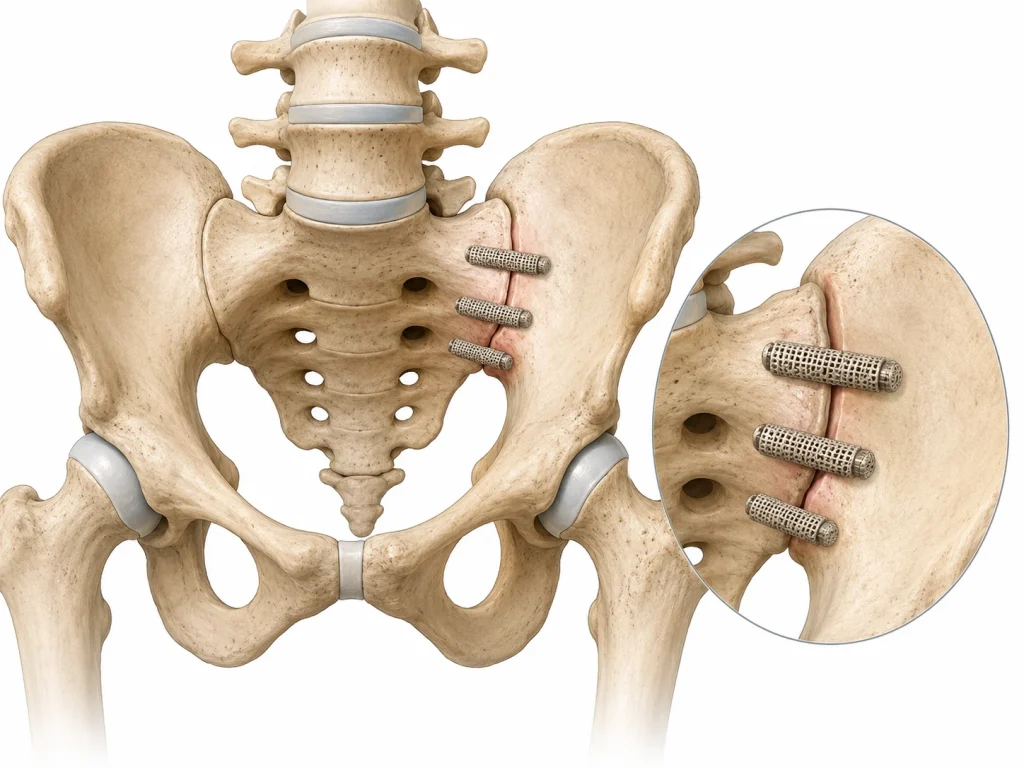
The sacroiliac joint, where your spine connects to your pelvis, is a common source of exactly this pain, frequently overlooked because its symptoms look like a spine problem. When standardinterventional pain management hasn’t gotten to the root of it, the SI joint is worth a closer look, and it’s one of the conditions we evaluate most often for patients in Augusta and the surrounding area.
If SI joint fusion surgery is a term you’ve started researching, here’s a straight answer: what separates SI joint pain from other low back problems, what fusion involves, and who tends to be a good candidate.
SI Joint Pain Looks Different From Other Low Back Pain
SI joint pain settles in the lower back just below your waistline, spreads into the buttock or upper thigh rather than down past the knee, and flares with sitting for long stretches, standing on one leg, or that first push to stand after sitting.
That pattern differs from other low back problems. Disc-related pain travels past the knee into the calf or foot and worsens with bending or prolonged sitting. Hip-related pain centers in the groin and flares with hip movement, like twisting to get out of a car or climbing stairs.
These areas sit close together and share overlapping nerve pathways, part of why SI joint dysfunction gets misread as a spine or hip issue. Imaging makes this harder, not easier. An MRI or X-ray often comes back clean even when the SI joint is driving the pain, since scans catch structural damage and dysfunction is usually a problem with how the joint moves. A real answer depends on a provider who knows what to look for.
How Pain Management Doctors Confirm SI Joint Pain
A hands-on exam, moving your hip and lower back through positions designed to reproduce your pain, is the first step. No single movement is reliable alone, but a consistent pattern points toward the joint.
Real confirmation comes from adiagnostic sacroiliac joint injection, which numbs the joint temporarily. Significant relief, even short-lived, signals the SI joint is the source.
How Minimally Invasive SI Joint Fusion Fixes the Problem Through a Small Incision
Hearing “fusion” brings up images of major spinal surgery and a long recovery. Minimally invasive SI joint fusion isn’t that. It’s done through a small incision and targets one joint rather than the spine.
Small implants are placed across the joint to hold it stable, and bone grows around them over the following months, eliminating the abnormal motion generating your pain. The goal is to stop one joint from moving the wrong way, not to limit overall mobility.
This is also where SI joint fusion differs most from lumbar spinal fusion, which matters if a prior spine conversation made you hesitant. Lumbar fusion involves the spine itself and comes with a longer recovery. SI joint fusion is more contained, with weeks of healing rather than months of restricted activity.
What Patients Try Before Fusion Is Considered
Physical therapy to strengthen the muscles around the pelvis is typically the starting point, since a more stable pelvis can reduce strain on the joint. Injections into the SI joint confirm the source and, for a time, treat it directly.
Radiofrequency ablation sometimes comes next, using targeted heat to calm the nerves sending pain signals from the joint. If you’ve worked through these without lasting relief, fusion becomes a reasonable next conversation.
What Can Go Wrong After SI Joint Fusion
Common issues include temporary nerve irritation near the implant site, problems with implant positioning, and infection risk. Pain may not fully resolve if the SI joint wasn’t the only structure contributing to your symptoms. A confirmed source, rather than one assumed from imaging alone, lowers the odds of a disappointing outcome.
How Long Recovery Takes After SI Joint Fusion
Most patients walk with the help of a walker or crutches in the first few days, with activity kept light. By around 6 weeks, most progress to light activity, gradually reducing the assistance they needed early on.
Full recovery takes longer than 6 weeks suggests. The bone growth that completes the fusion continues over several months, easy to underestimate since you may feel better well before that finishes. Physical therapy plays a role throughout, shifting toward rebuilding strength as the joint stabilizes.
Improvement tends to be gradual, not immediate. Expect a steady return to function over weeks and months.
Who Is a Good Candidate for SI Joint Fusion
A strong candidate is typically someone whose SI joint has already been confirmed as the source through a diagnostic injection, not someone who simply suspects it. They’ve usually tried physical therapy and other conservative treatments without lasting relief, and the pain interferes with work, sleep, and daily life.
What matters is how your pain shows up, how it’s responded to treatment, and what testing has confirmed, not age or gender. Candidacy isn’t something you determine from a checklist online. It takes an actual evaluation.
SI Joint Fusion Evaluations in Augusta, GA
If you’re not sure you fit, that’s not a dead end. It might just mean you’re not there yet. If conservative treatments haven’t been fully tried, or no one has confirmed your SI joint as the source, the right next step is a thorough evaluation with apain management specialist in Augusta, not surgery.
You’ve spent a long time dealing with pain that no one quite explained. Now you have a clearer picture: what makes SI joint pain different, what fusion involves, and whether you’re likely a candidate.
Augusta Pain Center specializes in this kind of evaluation, the kind that gets to the actual source of pain instead of guessing. If you’re ready to find out whether your SI joint is what’s been driving yours, request an appointment with our Augusta, Georgia team and let’s get you a real answer.